
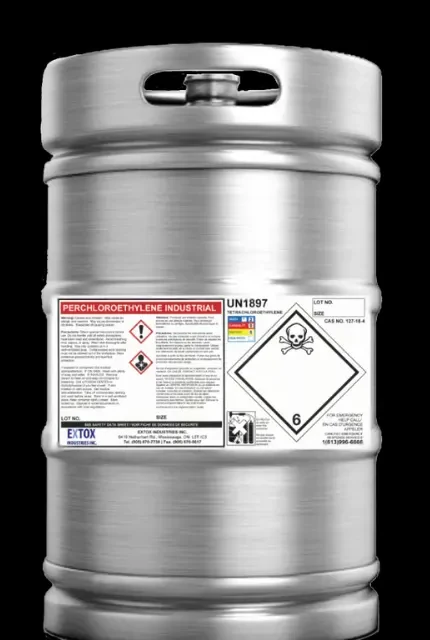
If you run PERC in Canada, secondary containment is not optional. It is written into the federal regulations, and it is one of the first things an inspector looks at. The good news is that the rules are clear and easy to meet once you know exactly what they ask for.
This article explains what the Tetrachloroethylene (Use in Dry Cleaning and Reporting Requirements) Regulations, SOR/2003-79, require for secondary containment, the mistakes we see most often, and how to check your own plant in fifteen minutes.
What the regulation says
Under section 5(f) of SOR/2003-79, a PERC dry cleaning machine may only be operated in a facility that has two things:
1. PERC-impermeable containment
A secondary containment system under each dry cleaning machine, tank or container that holds PERC, waste water or residue. It must cover at least the entire surface under the item and hold at least 110% of the capacity of the largest tank or container inside it.
2. Drain plugs on hand
PERC-resistant drain plugs, readily available to seal every floor drain that PERC, waste water or residue could reach in a spill.
Environment and Climate Change Canada’s guidance adds a practical detail that catches many owners out: rubber and bare concrete are not PERC-impermeable. PERC passes through concrete and can contaminate the soil and groundwater below a building. That is why corrosion-resistant or stainless steel trays are the usual choice.
What needs to be inside containment
It is not just the machine. Anything that holds PERC, PERC waste water or PERC residue needs its own containment or must sit inside a shared one. In a typical plant that includes:
- The dry cleaning machine itself
- Fresh PERC drums or storage tanks
- Waste water buckets or containers
- Waste water treatment units
- Sludge, still bottom and used filter drums
- Lint and button trap waste awaiting pickup
A useful test: walk around your plant and point at every container that has ever had PERC in it. Each one should be sitting in a tray, pan or containment platform.
How to work out the 110% capacity
Find the largest single tank or container inside the containment area. Your tray must be able to hold at least 110% of that volume. For example, if the biggest container in a tray is a 200 litre drum, the tray needs to hold at least 220 litres.
For a machine, use the capacity of its largest tank. Your machine manual or the manufacturer can give you the figure. If you share one containment area between several containers, size it for the largest one, not the total.
The mistakes we see most often
- Bare concrete floors counted as containment. They do not qualify.
- Rubber mats or berms used as trays. Rubber is not PERC-impermeable.
- Waste drums sitting outside the tray because “they are only temporary”.
- Trays that are too small after a machine or tank upgrade.
- Cracked, corroded or damaged trays that would leak in a real spill.
- Drain plugs stored somewhere nobody can find them, or no plugs at all.
- Open containers. The regulation also requires PERC, waste water and residue to be kept in closed containers except when you need access for operation or maintenance.
A 15-minute self-check
- Is the machine standing in a PERC-impermeable tray that covers its full footprint?
- Is every PERC, waste water and residue container inside containment?
- Can each tray hold 110% of the largest container in it?
- Are trays intact, clean and free of standing liquid?
- Are all containers closed?
- Are PERC-resistant drain plugs kept right next to the floor drains?
- Do your staff know what to do in a spill?
If you answered “no” to any of these, fix it before your next inspection. Most fixes are simple and inexpensive.
Containment is one part of compliance
Inspectors will also look at the rest of the regulation, including:
- Machine design requirements, such as a refrigerated condenser and a built-in PERC-water separator
- Sending waste water (unless treated as the regulation describes) and residue to an authorized waste management facility at least once every 12 months
- Records of PERC purchases and waste shipments, kept for five years
- Your annual report, due by April 30 for the previous calendar year
Our PERC compliance checklist covers all of these in one place, and our Audit Package helps you keep the paperwork inspection-ready.
Frequently asked questions
Does secondary containment apply to hydrocarbon or GreenEarth?
SOR/2003-79 applies to PERC. Other solvents have their own safety and fire code requirements, and good containment is still smart practice for any solvent.
Can I build my own tray?
You can use any system that is PERC-impermeable, covers the full surface under the item and holds 110% of the largest container. Stainless steel is the common choice because it resists PERC and corrosion.
Who picks up PERC waste?
It must go to a facility authorized to handle it. Extox provides licensed PERC waste pickup with the records you need for your annual report.
This article is a plain-language summary to help owners prepare. It is not legal advice. Always check the current text of SOR/2003-79 and Environment and Climate Change Canada guidance for your situation.
Want a second pair of eyes before an inspection?
Our compliance team can review your containment, waste handling and records and tell you exactly what to fix.


